
I. Popular Bestselling Coffee Machines in China 2025 (High Sales Volume + Strong Demand)
1. Core Household Categories (Accounting for 68% of Export Volume)
• Smart Capsule Coffee Machines
✅ Bestseller Logic: Catering to Gen Z’s needs for “convenience + personalization”, 15-second cup preparation + standardized taste, capturing 40% of the global market share in 2025.
✅ Representative Brands: Midea, Bear, Joyoung
✅ Core Selling Points: IoT connectivity (remote control via APP), self-cleaning function, compatibility with multi-brand capsules, average export price: $89-199
✅ Sales Data: A single factory in Cixi production area achieves annual exports exceeding 450,000 units; EU/US orders grow by 65% year-on-year.
• Full-Automatic Grinding & Brewing Integrated Coffee Machines
✅ Bestseller Logic: Meeting middle-class families’ demand for “professional-grade taste”, featuring bean-powder dual system + adjustable pressure (15-19bar)
✅ Representative Brands: Supor, Donlim
✅ Core Selling Points: Constant temperature extraction (±1℃ precision), AI taste memory; models in the $1,000-2,500 price range hold 72.4% of the global high-end household market share
✅ Certification Advantages: Full compliance with CE/UL/RoHS certifications; supports private label customization (OEM MOQ: 500 units)
2. Potential Commercial Categories (31.5% Export Growth Rate)
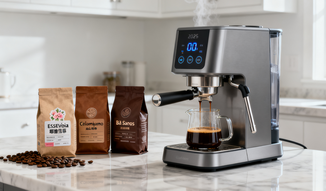
• Cost-Effective Italian Semi-Automatic Coffee Machines
✅ Bestseller Logic: Must-have for coffee shops/offices, priced at only 1/2 of imported counterparts (2,800-5,500) ✅ **Representative Brands**: Haier, Galanz ✅ **Core Selling Points**: 19bar high-pressure extraction + steam milk frothing system; digital production lines ensure 99.2% qualified product rate ✅ **Export Hotspots**: EU, Brazil, Southeast Asia; Cixi Customs data shows 4.7 million (330 million RMB) in exports from January to September 2025.
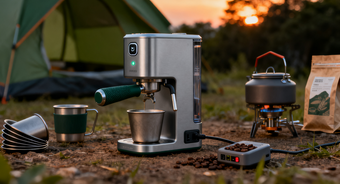
• Portable Mini Coffee Machines
✅ Bestseller Logic: Rising demand for outdoor/business trip scenarios, 80W low power consumption + 1-cup capacity design
✅ Representative Brands: Hibrew, Cyetus
✅ Core Channels: Bestsellers on Amazon/AliExpress, unit price: $49-89, annual sales exceeding 1 million units
Coffee Machine
II. Practical Guide for Overseas Procurement of Chinese Coffee Machines
1. Core Advantages of the Supply Chain (Why Choose China?)
- Production Capacity Guarantee: 80% of the world’s coffee machines are made in China; one unit rolls off the production line every 30 seconds in Shunde, with 90% of spare parts supplied locally.
- Cost Advantage: 30-50% lower price than European and American brands with the same configuration; supports modular customization (color/function/packaging).
- Complete Certifications: Full coverage of CE/CB/ETL/UL; leading factories can provide FDA food contact certification.
2. Procurement Process & Key Points to Avoid Pitfalls
| Steps | Key Actions | Practical Suggestions |
| Supplier Screening | Lock in core production areas | Prioritize manufacturers in Shunde, Ningbo, and Cixi (the world’s largest coffee machine production base) and Top 20 brands. |
| Sample Testing | Verify core indicators | Check extraction pressure stability, noise level (≤55dB), and continuous working time (≥8 hours for commercial machines). |
| Order Negotiation | Custom terms | OEM/ODM Minimum Order Quantity (MOQ): 500 units for household machines, 100 units for commercial machines; delivery cycle: 15-45 days. |
| Quality Control | Inspection standards | Request third-party test reports (e.g., SGS); focus on verifying heating element lifespan (≥5,000 uses). |
3. Recommended Key Suppliers (Top 5 Exporters 2025)
- Midea: Full-category coverage, 5% R&D investment ratio, supports global warranty.
- Supor: Affiliated to SEB Group, key supplier for the European market.
- Bear: Youthful design, bestseller manufacturer in e-commerce channels.
- Haier: Advantage in commercial models, complete global distribution network.
- Galanz: King of cost-effectiveness, flexible OEM customization.
III. 2026 Coffee Machine Industry Trend Forecast
1. Technological Iteration: Triple Breakthroughs in Intelligence, Energy Conservation, and Precision
Intelligent Connectivity Enters the “Full-Scenario Linkage” Stage
- Record-High Penetration: IoT function penetration will exceed 35% (AVC Cloud Q4 2025 forecast); models supporting Alexa/Google Home voice control and smart home ecosystem (e.g., linkage with refrigerators to monitor coffee bean inventory) will account for over 40%.
- AI-Enabled Personalized Experience: A surge in models equipped with taste recognition algorithms, which can automatically adjust grinding degree and water temperature (±1℃ precision) based on user drinking data; some high-end models support coffee bean origin adaptation programs (e.g., exclusive extraction parameters for Ethiopian beans).
- Remote O&M Becomes Commercial Standard: Commercial models will popularize “fault early warning + remote diagnosis” functions to reduce after-sales costs for overseas purchasers; leading Chinese factories have achieved 24/7 global technical support (e.g., Midea, Haier).
Green and Low-Carbon Becomes a Mandatory Requirement
- Upgraded Energy Efficiency Standards: Grade 1 energy efficiency models will account for over 60%, with standby power consumption ≤0.3W (40% lower than 2025); EU Carbon Footprint certification becomes an essential threshold for export.
- Environmentally Friendly Materials & Recycling Design: Food-contact grade degradable plastic and modular design of stainless steel bodies (easy to disassemble and recycle) become mainstream; China’s supply chain has achieved an 85% recycling rate of core components.
- Innovation in Energy-Saving Technologies: Popularization of waste heat recovery systems and intelligent start-stop functions; energy consumption per cup for commercial models reduces by 15%, aligning with European and American “green procurement” policy orientations.
Extraction Technology Sinks to “Professional Grade”
- Breakthrough in Localization of Core Components: Localization rate of ceramic grinders and 19bar high-pressure water pumps rises to 72%; household models achieve “coffee shop-level” extraction effects (e.g., Supor and Donlim launch home-use pre-infusion systems).
- Outbreak of Segmented Functions: Sales of specialized cold brew/ice drip models grow by over 50%; low-acid extraction and nitrogen preservation functions become standard for mid-to-high-end models, catering to Gen Z’s health needs.
Coffee Machine
2. Market Structure: Intensified Scenario Segmentation and Consumption Stratification
Household Market: Dual-Driver of “High-End Upgrading + Sinking Penetration”
- High-End Market: Market share of domestic commercial-grade household machines in the $2,000-3,000 price range will increase from 8% to 15%, focusing on “specialty coffee experience” and targeting European and American middle-class families (e.g., Haier’s “estate-level” customized models).
- Sinking Market: County-level and emerging markets (Southeast Asia, Middle East) become main growth drivers; exports of cost-effective models ($100-300, drip coffee makers + basic capsule machines) grow by over 45%; Cixi, China has formed a “low cost + fast delivery” specialized supply chain.
- Outbreak of Scenario-Specific Categories: Car coffee machines (compatible with new energy vehicles’ 12V power supply) and camping portable models (weight ≤500g) achieve over 60% annual sales growth; Amazon/AliExpress serve as core shipping channels.
Commercial Market: “Miniaturization + Cost-Effectiveness” Replacing Imports
- Must-Have for Specialty Coffee Shops: Chinese brands’ market share in mid-range commercial semi-automatic models ($15,000-30,000) will exceed 30%, with core advantages of “1/2 price + same configuration as imported models” (e.g., Galanz’s dual-boiler models targeting Delonghi).
- Customization for Office Scenarios: Rise of “20-person mini commercial machines” suitable for small offices, supporting dual-use for beans and powder + fast cup preparation (30 seconds/cup); Chinese factories offer corporate LOGO customization (MOQ as low as 100 units).
3. Ecological Model: From “Hardware Sales” to “Service Closed Loop”
Consumable Linkage Becomes the Core of Profits
- Fierce Competition in the Capsule Ecosystem: Domestic compatible capsule systems (compatible with Nespresso/illy) will cover 80% of mainstream models; purchasers can reduce costs through “equipment + capsule” bundled procurement; China’s supply chain has achieved an annual capsule production capacity exceeding 5 billion units (Jiaxing, Zhejiang production area).
- Popularization of Subscription Models: Overseas purchasers can access Chinese brands’ “automatic consumable replenishment” platforms, which predict inventory through IoT data to reduce logistics and warehousing costs.
Coffee Machine
4. Core Opportunities of China’s Supply Chain (Procurement Focus)
- Technological and Cost Advantages: 89% localization rate of intelligent modules; 35-50% lower price than European and American brands with the same configuration, supporting function customization (e.g., adding multilingual operation panels).
- Continuation of Policy Dividends: 13% export tax rebate for Chinese home appliances; green and intelligent models can enjoy additional cross-border logistics subsidies (e.g., special policies of Ningbo and Shenzhen Customs).
- Production Capacity and Delivery Guarantee: 90% local supply of core components in Shunde and Cixi production areas; delivery cycle for regular orders shortened to 12-20 days, and mass production of customized models achievable within 30 days.
Share This Story, Choose Your Platform!
We connect you with reliable factories, get the best quotes, deliver straight to your door.