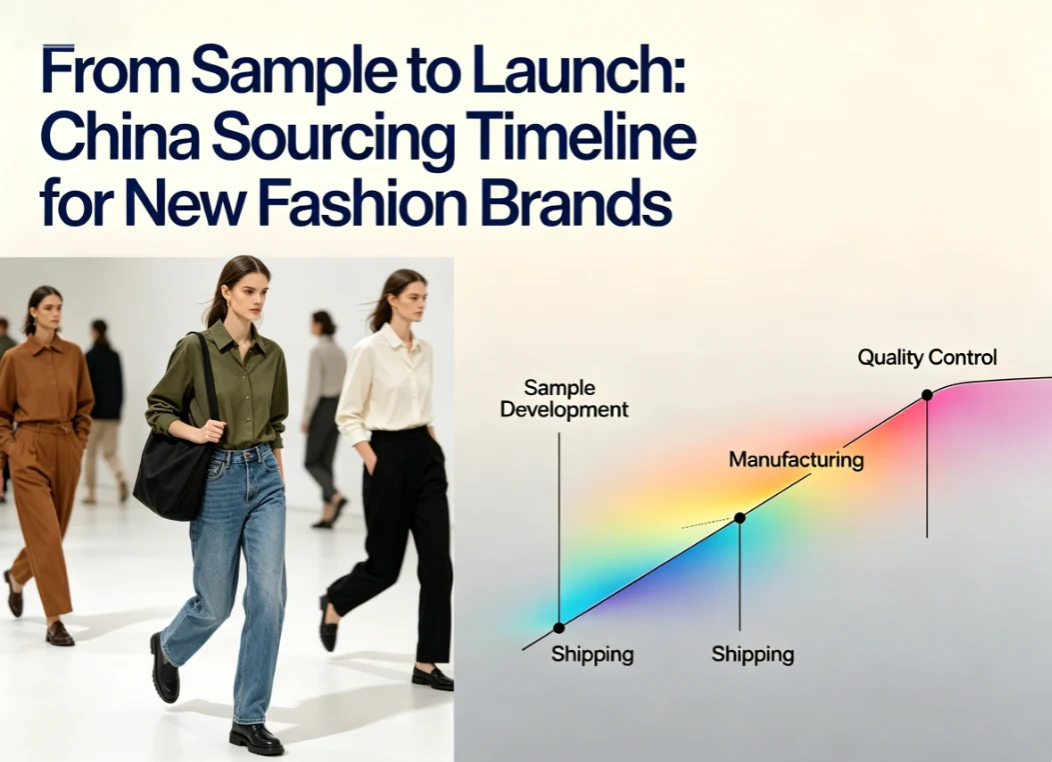
For new fashion brands, nothing kills a collection faster than poor timeline management. Many emerging designers and startup labels spend months perfecting designs, only to face endless delays in sampling, production, and shipping. Missed seasonal windows, rushed quality checks, and last-minute logistics chaos are the most common pitfalls of China sourcing timeline planning for first-time brand owners.
Unlike established fashion companies with dedicated supply chain teams, new fashion entrepreneurs often underestimate how long each sourcing step takes. Without a clear China sourcing timeline from sample development to official product launch, startups either launch too late and lose market opportunities or rush production and receive defective, inconsistent batches that ruin brand reputation.
China’s apparel supply chain is fast and flexible, but it still follows fixed industrial workflows. Every stage—factory vetting, sample making, confirmation, bulk production, quality inspection, packaging, and delivery—requires a reasonable cycle. This guide breaks down a complete, realistic China sourcing timeline exclusively for new fashion brands. It provides stage-by-stage schedules, key tasks, common delays, and actionable tips to help you smoothly take your designs from initial samples to official market launch.
Overall Standard Sourcing Timeline Overview
For most new fashion brands launching small-batch private label collections (50–200 pieces per style), the full cycle from blank design drafts to finished launch-ready products takes 6–10 weeks under standard conditions. Fast-track orders can be completed in 4–5 weeks, while complex customized styles with exclusive molds, special craftsmanship, or custom packaging require 10–12 weeks.
Most timeline delays are not caused by factory efficiency, but by repeated sample revisions, unclear design requirements, late payment confirmation, and unplanned schedule adjustments. Mastering each phase’s fixed workflow will help new brands control the rhythm of their China sourcing timeline steadily.
Phase 1: Factory Vetting & Technical Confirmation (Week 1)
Before making any samples, new fashion brands need to complete factory screening and technical docking. This lays the foundation for smooth follow-up progress. Many startups skip this step and directly arrange sampling, only to find the factory cannot meet their craftsmanship, MOQ, or customization requirements. That results in wasted time and having to find another factory.
Core tasks in this phase:
Screen verified apparel factories that match your product positioning
Confirm MOQ, unit price range, production capacity, and craftsmanship capabilities
Submit design drawings, tech packs, fabric requirements, size specs, and custom detail demands to the factory
Confirm whether the factory can achieve your expected effects
Lock in preliminary cooperation terms
Common delays:
Incomplete tech packs, unclear fabric parameters, frequent requirement changes, and slow factory communication responses.
Pro tips:
New brands must prepare complete technical documents in advance. Clear specifications reduce back-and-forth and help factories arrange sampling schedules right away.
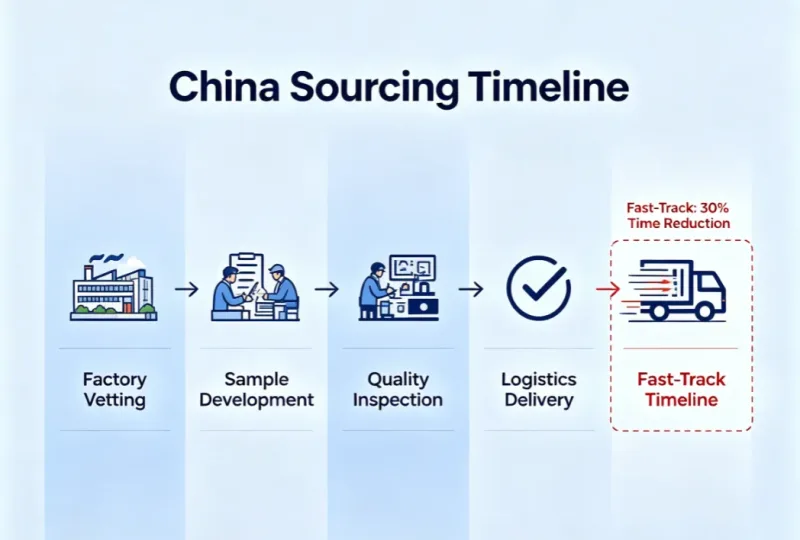
China sourcing timeline
Phase 2: Sample Development & Revision (Week 2–Week 4)
Sampling is the most critical and time-consuming link in the China sourcing timeline, and also the stage most prone to delays. For new fashion brands, samples determine the final product texture, silhouette, color tone, and craftsmanship standard. A stable sample confirmation standard ensures consistent bulk quality.
Standard sample cycle:
Initial prototype sample takes 7–10 working days
After receiving the sample, brands check fabric feel, size fit, stitching details, logo position, and overall styling
Most new brands need 1–2 rounds of revisions to adjust details like color difference, silhouette looseness, and accessory matching
Each revision takes another 3–5 working days
Key deliverables:
After multiple revisions, confirm the final pre-production sample. Lock all standards including fabric gram weight, Pantone color, stitching density, printing or embroidery effect, label placement, and washing process. The confirmed sample will serve as the only production standard for bulk goods.
Common mistakes causing delays: Indecisive revisions, repeatedly adjusting design details after sample completion, and failing to confirm samples in time. These directly push back bulk production schedules.
Phase 3: Bulk Production Arrangement & Manufacturing (Week 4–Week 7)
After pre-production sample confirmation, the factory officially launches bulk production. This phase accounts for the longest cycle in the entire China sourcing timeline and determines batch stability and delivery punctuality.
Standard production cycle:
For conventional casual styles (t-shirts, hoodies, basic dresses), small-batch production of 50–200 pieces takes 15–20 working days
For complex styles like tailored suits, vintage washed garments, and multi-process customized pieces, the cycle extends to 20–25 working days
Core production workflow:
Raw fabric preparation and pre-shrinking → cutting → sewing and assembly → custom printing, embroidery, or accessory installation → washing and finishing → preliminary factory inspection
New brand reminder:
During bulk production, do not change design details or add new customization requirements. Temporary adjustments will force the factory to restart production arrangements, causing serious delivery delays and higher costs.
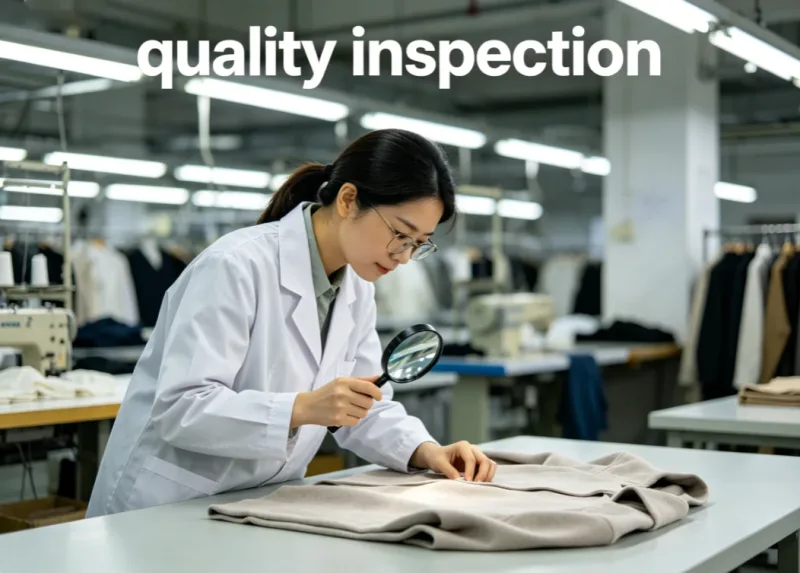
quality inspection
Phase 4: Quality Inspection, Rework & Packaging (Week 7–Week 8)
Many new fashion brands skip independent inspection time and directly arrange shipment after factory production. That leads to defective products reaching customers and hurting your launch. Building in inspection and buffer time is essential for a professional brand launch.
QC and packaging cycle:
Professional finished product inspection takes 2–3 working days, including random sampling and full inspection of appearance, size, color difference, stitching, and accessories
For defective individual products, arrange targeted rework and repair
After full compliance, proceed with folding, tagging, custom packaging, and box loading
Key advantage for brand building:
Unified packaging and strict finished product screening ensure every item presents a professional brand image. This avoids inconsistent products hurting the customer experience during your first launch.
Phase 5: Logistics, Customs Clearance & Arrival (Week 8–Week 10)
The final step from factory completion to warehouse arrival is also prone to unexpected delays. Many new brands only calculate production time but ignore logistics and customs cycles, which leads to missed sales seasons.
Logistics timeline reference:
Air freight (suitable for small-batch urgent launches) takes 7–10 days including customs clearance
Sea freight (suitable for large-batch cost-effective orders) takes 25–35 days
For European and American markets, add an extra 3–5 days of buffer time for customs inspection and document verification
Operation suggestion:
New brands launching seasonal collections should prioritize air freight for the first batch to ensure launch timeliness and catch trend windows.
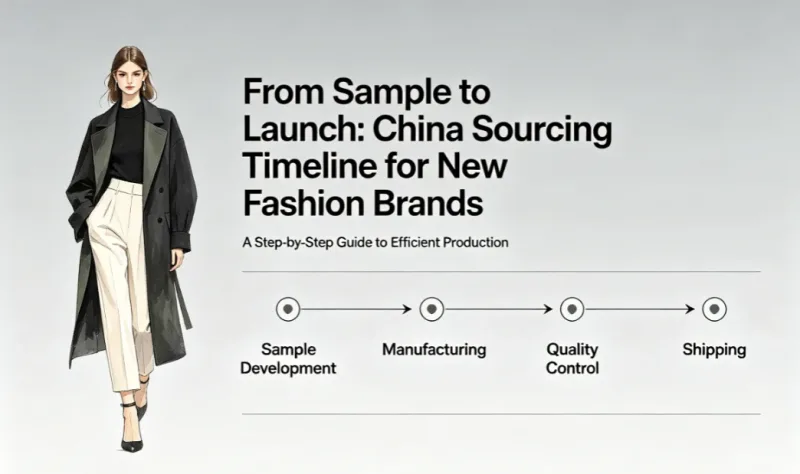
From Sample to Launch_ China Sourcing Timeline for New Fashion Brands
Fast-Track Timeline (4–5 Weeks) for Urgent Launches
For new fashion brands with urgent launch needs, mature China supply chains support compressed fast-track cycles. This works well for trend-style trial sales and flash collection launches.
Compressed schedule:
1 week for factory docking and quick sample confirmation
2 weeks for priority bulk production
1 week for inspection and air freight delivery
Fast-track orders require simple, fixed styles with no repeated revisions. Factories need to give you priority production. This approach is very suitable for new brands wanting to test market trends quickly.
Top 6 Timeline Mistakes New Fashion Brands Must Avoid
1.No buffer time reserved – New brands often schedule tightly based on ideal cycles, ignoring rework, weather delays, and customs inspection uncertainties. That leads to missed launch dates.
2.Frequent sample revisions – Indecisive design adjustments drag out the sampling cycle. This is the biggest reason for overall schedule delays.
3.Starting production without confirmed samples – In pursuit of speed, some brands rush bulk orders before sample locking. That leads to large defective batches and full-order rework.
4.Incomplete pre-production documents – Unclear tech packs, size charts, and color standards cause repeated factory communication and slower progress.
5.Ignoring seasonal peak cycles – Production periods before Christmas, summer vacation, and Canton Fair are factory peak seasons with tight schedules. Failing to plan ahead will delay delivery.
6.Underestimating logistics time – Only counting production days while ignoring customs clearance and transit time causes missed sales windows.
Core Tips to Stabilize Your Launch Timeline
First, put together a fixed project schedule and clarify the latest completion date for each step. Second, lock in all design and process details before sampling to avoid repeated revisions. Third, work with stable small-batch factories that understand startup brand rhythms and can offer priority production. Fourth, add 1–2 weeks of flexible buffer time for unexpected risks. Finally, complete QC and packaging early to ensure zero-delay shipment.
Final Takeaways
For new fashion brands, a solid, realistic China sourcing timeline is just as important as product quality and design creativity. The whole process—sample development, bulk production, quality inspection, and logistics delivery—determines whether your collection launches on schedule, captures market trends, and makes a strong first impression.
Most startup sourcing delays are avoidable. By standardizing each stage’s workflow, locking in details early, avoiding repeated adjustments, and building in enough buffer time, new fashion brands can efficiently go from sample confirmation to official launch. That lays a solid foundation for long-term brand growth and market expansion.
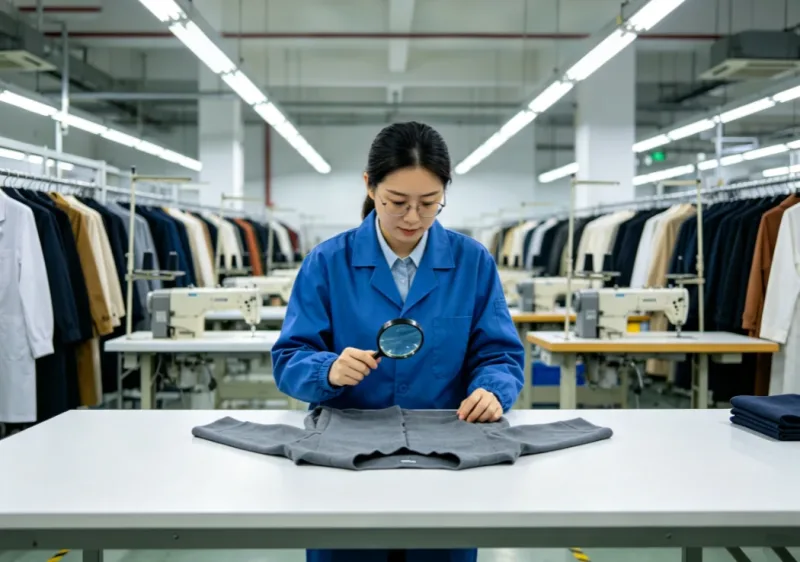
Garment Quality Inspection
How SourcingYuan Streamlines Your China Sourcing Timeline
At SourcingYuan, we specialize in one-stop, timeline-controlled sourcing services for new fashion brands. We understand that startup brands need efficient, stable, and predictable launch cycles. We help you avoid the many time-wasting steps that come with traditional China sourcing.
For each order, we assign professional project tracking, create a custom production schedule, supervise sampling progress, lock standards in one go, prioritize factory production slots, arrange timely QC inspection, and coordinate efficient logistics. We shorten your brand’s overall launch cycle while keeping product quality stable. That helps new fashion brands quickly complete market trials and official collection launches.
📧 Email: lee@sourcingyuan.com
If you’re a new fashion brand looking for a stable, efficient, and time-controlled China sourcing timeline solution, reach out. We’ll create a custom sample-to-launch timeline plan for your collection.
Share This Story, Choose Your Platform!
We connect you with reliable factories, get the best quotes, deliver straight to your door.