If you’re sourcing from China, you’ve likely felt the frustration of supplier discovery: sifting through thousands of listings, requesting quotes that never arrive, or receiving samples that don’t match specifications. The challenge isn’t finding any supplier—it’s finding the right supplier.
China’s industrial clusters offer a practical solution. A French executive recently described China’s manufacturing ecosystem as “the place where problems get solved overnight”. This isn’t hyperbole—it’s a reflection of how geographically concentrated, interconnected supplier networks can dramatically improve your sourcing outcomes. This is where cost efficiency comes from—not just lower prices, but better overall value.
This guide explains how to leverage industrial clusters for supplier sourcing—moving beyond random online searches to a strategic approach that saves time, reduces risk, and delivers better partners.
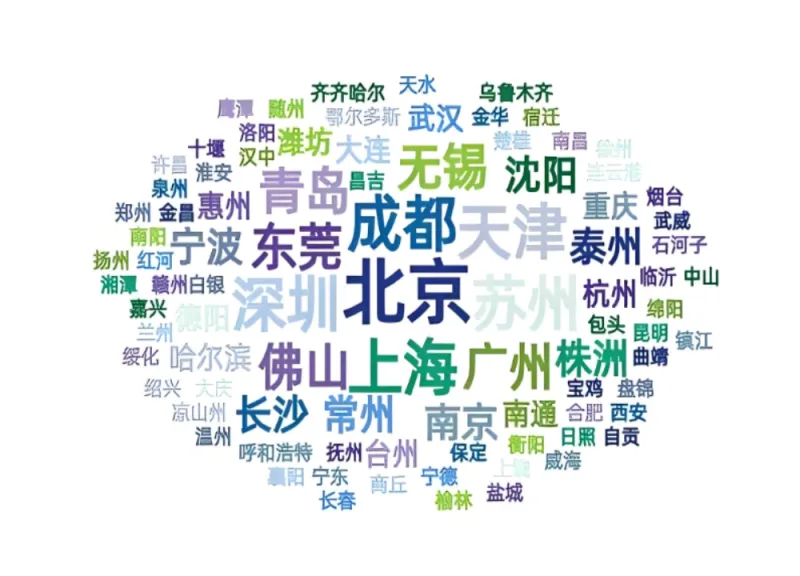
Word Cloud Map of City Distribution of National Advanced Manufacturing Clusters
What Are Industrial Clusters and Why Do They Matter?
An industrial cluster is a geographic concentration of interconnected businesses, suppliers, and service providers in a specific industry. The Yangtze River Delta and the Guangdong-Hong Kong-Macao Greater Bay Area are prime examples.
The advantage for buyers is simple: supply chain integration. When you source from a cluster, you’re not just evaluating a single factory. You’re tapping into a supplier ecosystem where:
Suppliers sit close to component, tooling, and material providers, enabling rapid prototyping and production ramp.
Engineers, suppliers, and customers can solve problems face to face rather than across continents.
Design changes reach suppliers quickly, tooling is modified within hours, and production resumes with minimal disruption.
These industrial agglomeration benefits create what executives describe as “system-level certainty”—the ability to innovate, manufacture, and deliver efficiently within an integrated ecosystem.
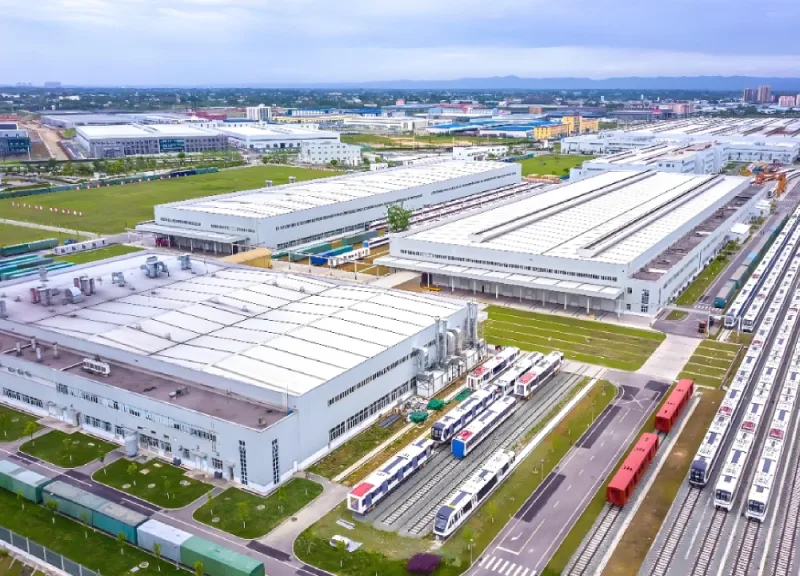
Aerial view of the factory
How Clusters Help You Find Better Suppliers
Supplier Density Means More Options, Better Selection
In a cluster, you can compare dozens of suppliers within a few kilometers. This density creates natural competition that drives quality and service improvements.
For example, Chinese manufacturing clusters like Shenzhen’s electronics hub or the Yangtze River Delta’s automotive network host thousands of China manufacturing clusters that specialize in specific product categories. This concentration makes it easier to find reliable manufacturers in China because you can:
Visit multiple factories in a single day for side-by-side comparisons.
Benchmark pricing and quality across multiple suppliers.
Identify specialized capabilities that generalist suppliers lack.
Shared Infrastructure Lowers Your Risk
When you source from a cluster, your supplier benefits from shared logistics, testing facilities, and skilled labor pools. This translates to:
Faster production lead times (typically 2–6 weeks for standard orders).
More reliable on-time delivery—top suppliers achieve 98–100% delivery rates.
Better quality control through proximity to third-party inspection services.
Data from leading platforms shows that suppliers within established clusters consistently outperform isolated factories on key metrics: top performers maintain review scores above 4.8/5.0, reorder rates above 25%, and response times under 2 hours.
Innovation and Speed-to-Market
In advanced manufacturing, speed itself has become a competitive advantage. Clusters enable this through:
Rapid prototyping—materials and tooling are available locally.
Shorter feedback loops—engineers can visit suppliers in person.
Knowledge spillover—suppliers learn from each other and from their anchor customers.
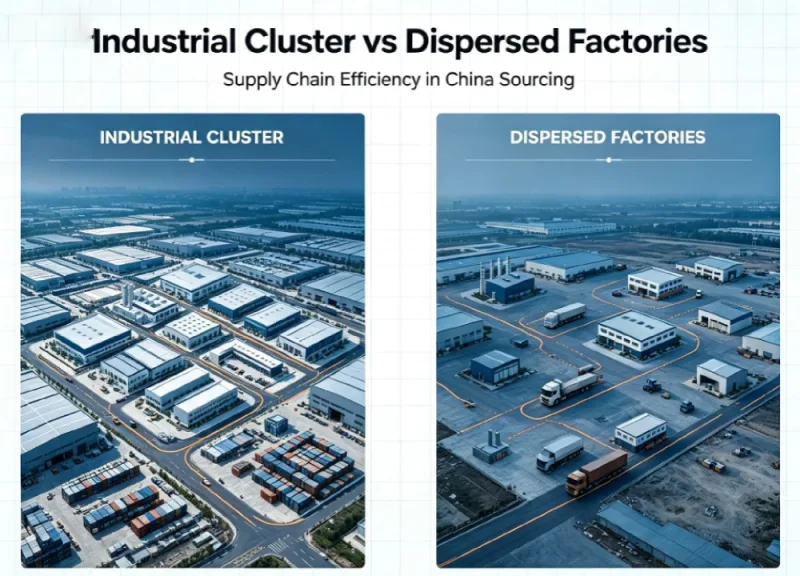
Industrial Cluster vs Dispersed Factories_ Aerial View Comparison for China Sourcing
A Practical Framework: How to Identify and Evaluate Suppliers Within Clusters
Step 1: Identify the Right Cluster for Your Product Category
Start by mapping your product to the appropriate industrial clusters in China:
| Industry | Key Clusters | Advantage | Target Buyer |
| Electronics | Shenzhen, Dongguan | Dense component networks, rapid prototyping | Tech startups, electronics brands, hardware importers, smart device retailers |
| Automotive | Yangtze River Delta | Integrated supply chains, 4-hour parts radius | Automotive manufacturers, auto parts distributors, vehicle modification brands |
| Textiles | Zhejiang, Guangdong | Vertical integration, fabric to finished goods | Fashion apparel brands, garment factories, fabric wholesalers, clothing importers |
| Machinery | Shandong, Jiangsu | Heavy equipment expertise, skilled workforce | Industrial equipment companies, engineering firms, hardware machinery distributors |
| Consumer Goods | Yiwu, Guangzhou | Low MOQs, variety, export logistics | Cross-border sellers, daily commodity retailers, promotional product importers |
If you’re unsure which cluster fits your product, a China sourcing company with local expertise can help you navigate the landscape—matching your product specifications to the right manufacturing hubs and verifying suppliers on your behalf.
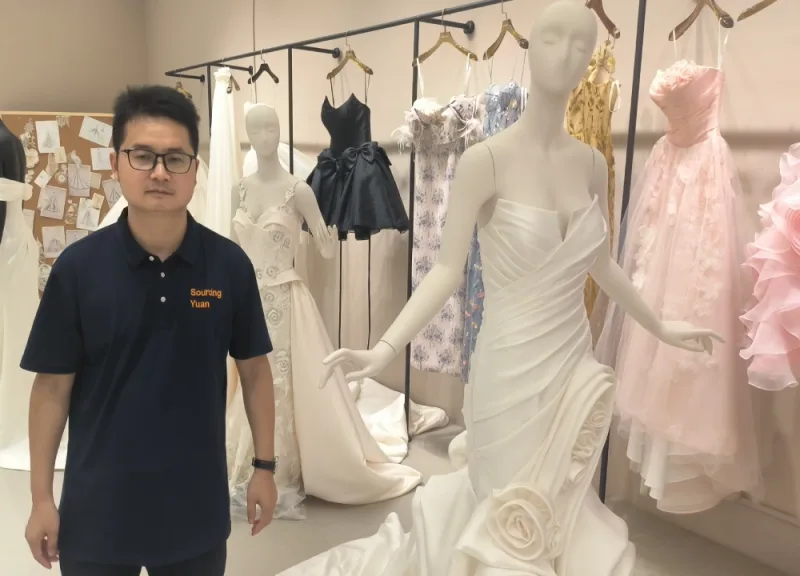
Lee at the wedding dress factory.
Step 2: Use Performance Data to Shortlist Suppliers
Once you’ve identified a cluster, leverage platform data to identify qualified Chinese suppliers:
Key metrics to evaluate:
On-time delivery rate > 97% indicates operational reliability.
Reorder rate > 25% signals strong customer retention and quality consistency.
Review score > 4.8/5.0 reflects consistently positive buyer feedback.
Response time < 2 hours suggests good communication capacity.
For example, one electronics supplier in Shenzhen maintains 100% on-time delivery with a 21% reorder rate, showing stable output and consistent quality control.
Step 3: Validate Through the Cluster Ecosystem
Cluster sourcing enables validation methods that aren’t practical with isolated suppliers:
Factory visits: About 80% of Chinese manufacturers welcome buyer visits. Factories in Guangdong and Jiangsu often have dedicated visitor centers and demonstration areas.
Virtual tours: Many suppliers—especially those in tech hubs—offer video walkthroughs for international buyers unable to travel.
Third-party audits: Clusters have dense networks of inspection services. Consider requesting ISO 9001, CE/FCC, or REACH certifications, particularly for electronic or safety-sensitive goods.
Local partner support: For buyers who cannot travel to China, working with a local partner like SourcingYuan can bridge the gap. Our Guangzhou-based team conducts on-site factory visits, verifies production capabilities, and coordinates sample testing—so you get the same level of visibility as if you were there in person.
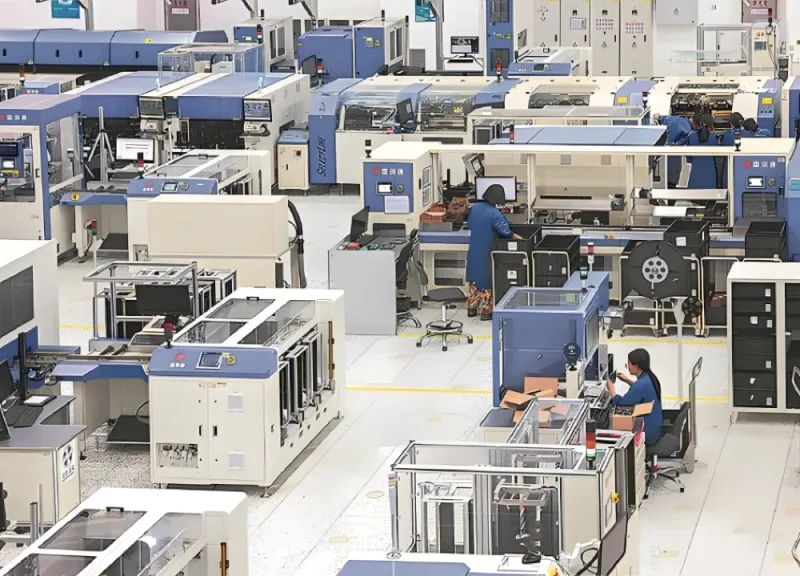
China Industrial Clusters, Modern Electronics Manufacturing Factory Workshop
Step 4: Start with Samples and Test Orders
Never commit to bulk orders without validation.
Sample phase: Most suppliers deliver samples within 7–15 days, with complex prototypes requiring 15–25 days. Established suppliers typically charge $20–$100 for samples, often credited toward future orders.
Apparel sourcing note: For apparel sourcing, sampling is particularly critical—fabric quality, color accuracy, and sizing consistency can only be verified through physical inspection. The same principle applies across categories, but clothing buyers should budget for at least 2–3 sample rounds before production approval.
Trial orders: Place a small-volume order (e.g., 1–2 units for machinery, 50–100 for apparel) to evaluate packaging, documentation, and shipping accuracy.
Red Flags and How to Avoid Them
Even within clusters, not all suppliers are equal. Watch for:
| Red Flag | What to Do |
| On-time delivery below 95% | Request recent delivery records; consider alternative suppliers |
| Vague response to technical questions | Request detailed product specifications and compliance documentation |
| Request for full payment upfront | Use escrow services or milestone-based releases |
| Inconsistent communication | Set clear expectations for response cadence; test with follow-ups |
A supplier with 85.7% on-time delivery may still be viable for some applications, but requires closer monitoring before scaling orders.
Even within well-known industrial clusters, cluster location cannot replace strict supplier qualification and audit work. Buyers should never judge a supplier’s reliability solely by its cluster location; full verification of credentials, production capacity, and product quality is always essential for stable long-term cooperation.
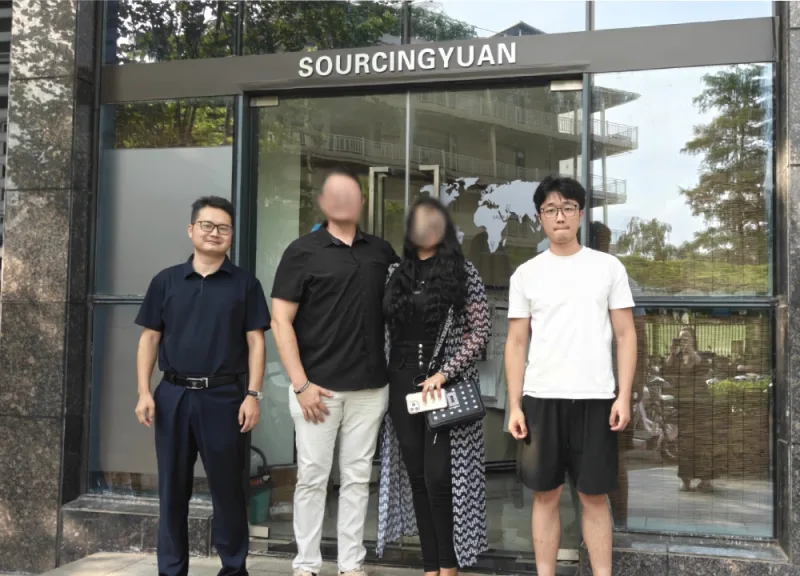
Group photo of the Guangzhou team and clients
Beyond the Transaction: Building Strategic Partnerships
The most successful sourcing relationships evolve beyond transactional buyer-supplier dynamics. When you source from a cluster, you have the opportunity to build partnerships that deliver:
Collaborative innovation: Suppliers in clusters often have R&D capabilities that can contribute to your product development. Some operate as OEM/ODM partners, offering end-to-end customization including graphic design and branded labeling.
Supply chain resilience: System-level certainty comes from reliable suppliers, experienced engineers, integrated industrial clusters, and resilient logistics. These capabilities cannot be replicated simply by relocating a factory—they are the result of decades of industrial accumulation and close collaboration across supply chains.
Priority treatment: Suppliers who view you as a partner—not just a one-time order—offer better terms, faster responses, and more flexibility during busy seasons.
FAQ
What are the best China industrial clusters for electronics sourcing?
Shenzhen and Dongguan form the core electronics cluster, offering dense component networks and rapid prototyping capabilities. For smart devices and consumer electronics, this region is unmatched.
How do I verify a supplier’s production capacity within a cluster?
Ask for machine counts, workforce size, or monthly output benchmarks. Cross-check with listed product ranges—suppliers offering diverse variations typically have flexible tooling. Trial orders remain the most effective validation method.
Can I visit a factory before placing an order?
Yes—approximately 80% of Chinese manufacturers welcome buyer visits. Factories in Guangdong and Jiangsu provinces usually have dedicated visitor centers and demonstration areas. Schedule visits through your sales representative at least 7–10 days in advance.

End-to-end partnership solution for apparel sourcing
What certifications should I expect from a qualified supplier?
Essential certifications include ISO 9001 (quality management), CE/FCC (electronics), REACH (chemical compliance for EU), and CPSIA (U.S. safety standard for children’s products). For specific industries, additional certifications may apply.
How long does production typically take?
Standard production lead times range from 2 to 6 weeks depending on complexity and order volume. Suppliers with rapid response times often streamline internal workflows to accelerate production cycles, particularly for standard configurations.
What is a typical MOQ for sourcing from clusters?
MOQs vary by product category. Basic plastic or resin products may require 500 units; crystal-embedded designs, 200–300 units; electronic/smart devices, 100–500 units; handcrafted items, 300–800 units. Some suppliers accept orders as low as 50 units for market testing.
The Bottom Line
China industrial clusters are not just collections of factories—they are ecosystems that offer supply chain integration, cost efficiency, and system-level certainty that isolated suppliers cannot replicate.
By focusing your search within the right manufacturing clusters, using performance data to identify qualified Chinese suppliers, and validating through samples and audits, you can move beyond the noise of supplier discovery to build reliable, long-term partnerships.
Leverage industrial clusters for supplier sourcing to build supply chain resilience. The strategy for supplier selection in China is shifting from chasing the lowest price to finding partners who offer transparency, responsiveness, and scalability. Those capabilities are concentrated in China manufacturing clusters—and that’s where you’ll find your best suppliers.
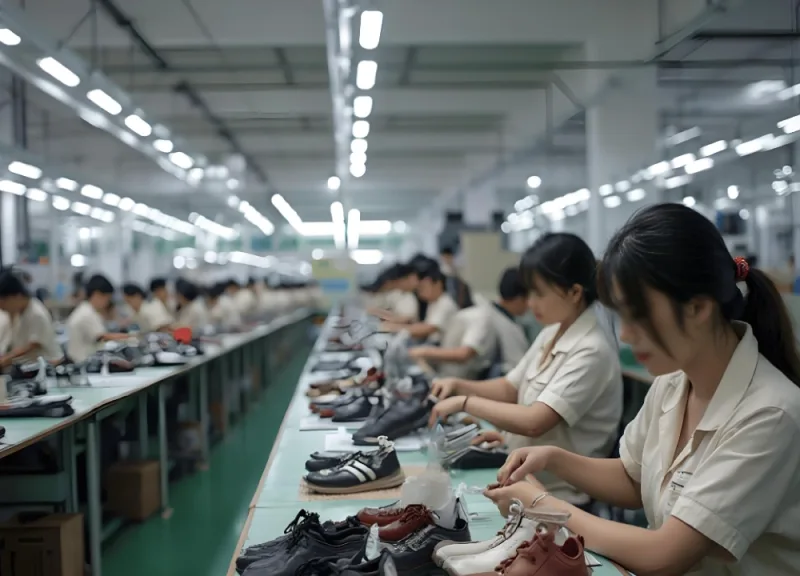
China Industrial Clusters, Quanzhou Sneaker Manufacturing Factory Production Line
About the Author
Jeff Lee
Founder of Sourcingyuan
Jeff Lee is the founder of Sourcingyuan, a China-based sourcing and product development company. He has more than 10 years of experience helping overseas businesses source products, develop new products, identify reliable manufacturers, manage production, and build supply chains in China.
Connect with Jeff: LinkedIn | YouTube
If you’re learning about China industrial cluster sourcing, these related guides will strengthen your supply chain strategy:
→ What Are China Industrial Clusters and Why Do They Matter for Global Sourcing?
→ Which Chinese Cities Are Ideal for Sourcing Within China Industrial Clusters?
→ Factory Audit Guide for China Sourcing
→ Contact SourcingYuan
Share This Story, Choose Your Platform!
We connect you with reliable factories, get the best quotes, deliver straight to your door.