A Practical Guide for European Wholesalers and Importers
When European wholesalers and importers place their first custom apparel order with a Chinese factory, the biggest risk is rarely a weak design or a price that cannot be agreed. It is compliance that gets left until the very end.
By the time bulk production is finished, the care labels have already been sewn in and the container is waiting to be loaded, buyers discover that the composition label is in English only, that the nickel release of the buttons exceeds the limit, or that the hood drawstring on a children’s sweatshirt is non-compliant. Remedial costs at that point are often ten times the cost of the conversations that should have happened earlier. Worse still, many of these problems cannot be solved by rework at all: the entire batch simply cannot enter the EU market.
As a sourcing partner that has served European clients for years, we have mapped the problems that wholesalers and importers genuinely run into when placing custom apparel orders in China, in the order in which they appear along the production flow. You can use it as a self-check list.
For full context across the whole production workflow, explore our complete apparel‑sourcing guide.

Before You Place the Order: Fix the Label Language First, Not After Printing
This is the item most often overlooked, and the one most likely to trigger a full-batch rework.
Legal basis: (EU) No 1007/2011, the Regulation on textile fibre names and related labelling and marking of the fibre composition of textile products.
The Regulation requires that, unless a Member State provides otherwise, the fibre composition of a textile product must be indicated to consumers in the official language of the Member State in which the product is sold.
This means one thing: an English-only label is non-compliant.
You have probably seen this five-line “repetition” on labels in the market:
85% COTTON / 15% POLYESTER
85% COTON / 15% POLYESTER
85% BAUMWOLLE / 15% POLYESTER
85% COTONE / 15% POLIESTERE
85% ALGODÓN / 15% POLIÉSTER
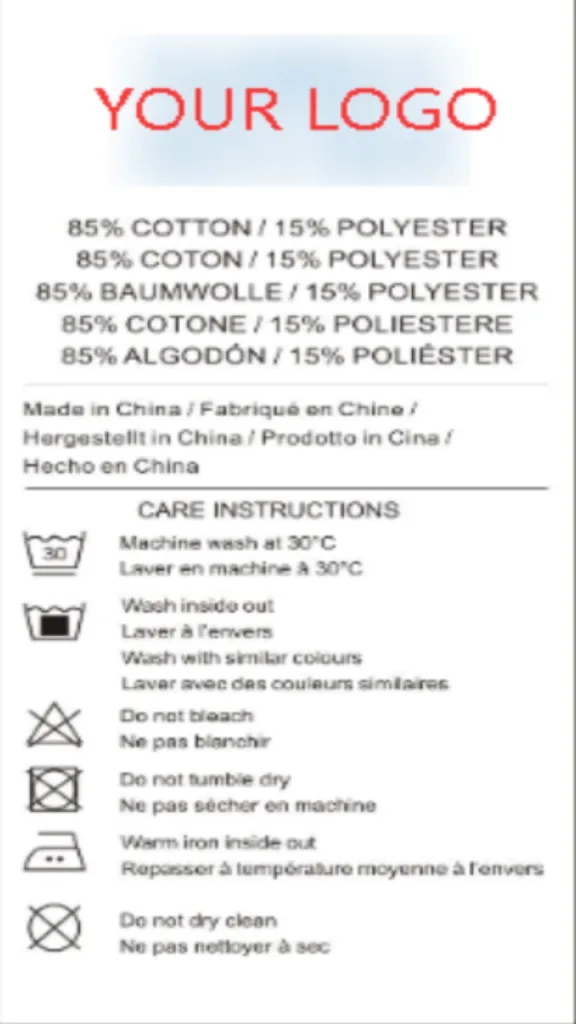
This is not a printing error; it is a compliance requirement. The same composition information is written out once in each of five languages – English, French, German, Italian and Spanish – so that a single batch can be distributed across several countries without producing country-specific labels.
In practice you have two options:
Label language options
| Option | Where it applies | Description |
|---|---|---|
| Single language | Shipments to one country only | For example Germany only: German text (we recommend adding English as a backup) |
| Parallel multi-language | Distribution across several countries | English/French/German/Italian/Spanish in five parallel lines, sometimes plus Dutch and Portuguese |
Parallel multi-language labelling is the mainstream approach today: one batch can serve several markets, with no need for country-specific care labels.
⚠️Key reminder from SourcingYuan: the language decision must be made before sampling. Once the care label mould is printed, any change means redoing the whole batch. If you have not yet finalised which countries you will sell into, go straight to the multi-language version. The additional cost is limited, and it saves you the trouble of redoing labels country by country later.
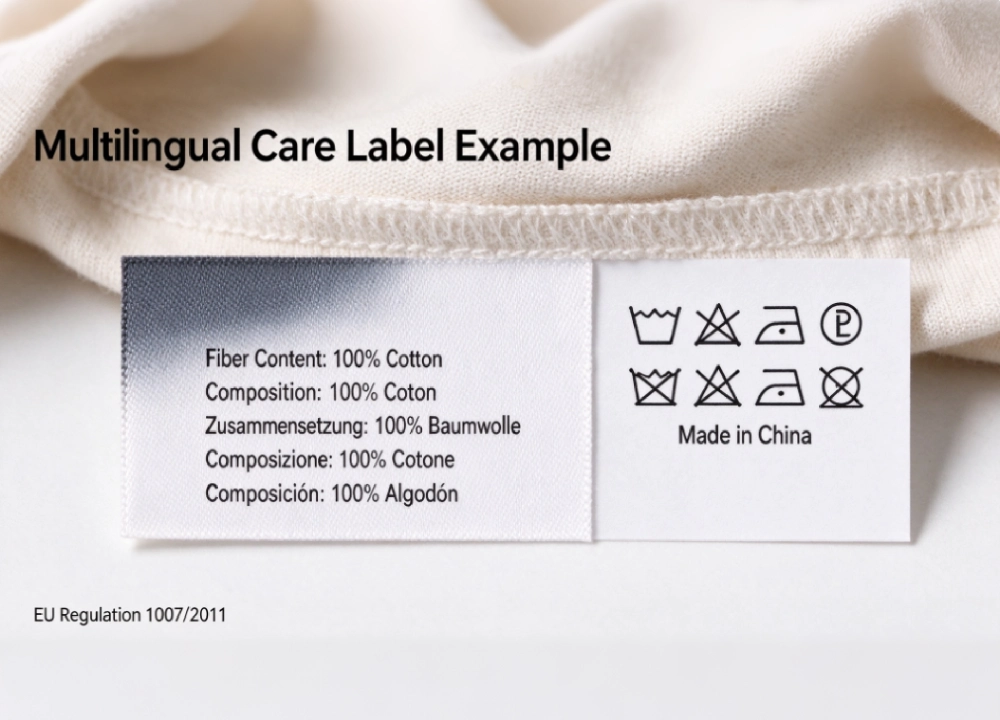
Fibre Composition Labelling: Five High-Frequency Errors
Regulation 1007/2011 sets very specific rules for composition labelling. The five points below are where Chinese factories most often get it wrong.
Fibre names must be the official names
Only the standard names listed in Annex I of the Regulation may be used. “Lyocell” is acceptable; a trade name you invented is not. A trade name may only appear as supplementary information and can never replace the official name.
Composition must be listed in descending order by weight
“85% cotton / 15% polyester” is correct. Written the other way round, it is non-compliant.
Multi-component products must be labelled separately
For a jacket, the shell fabric, lining and filling must be listed separately and cannot be merged into one figure.
Animal origin must be declared separately
Products containing leather, fur or down must carry the additional statement: “Contains non-textile parts of animal origin.” Missing this line is a common trigger for customs inspection.
The label must be durable, permanent and visible
It must be sewn in or permanently printed. Stickers are not acceptable, and the label may not be hidden on the inside of a seam or somewhere that requires the garment to be opened before it can be read.
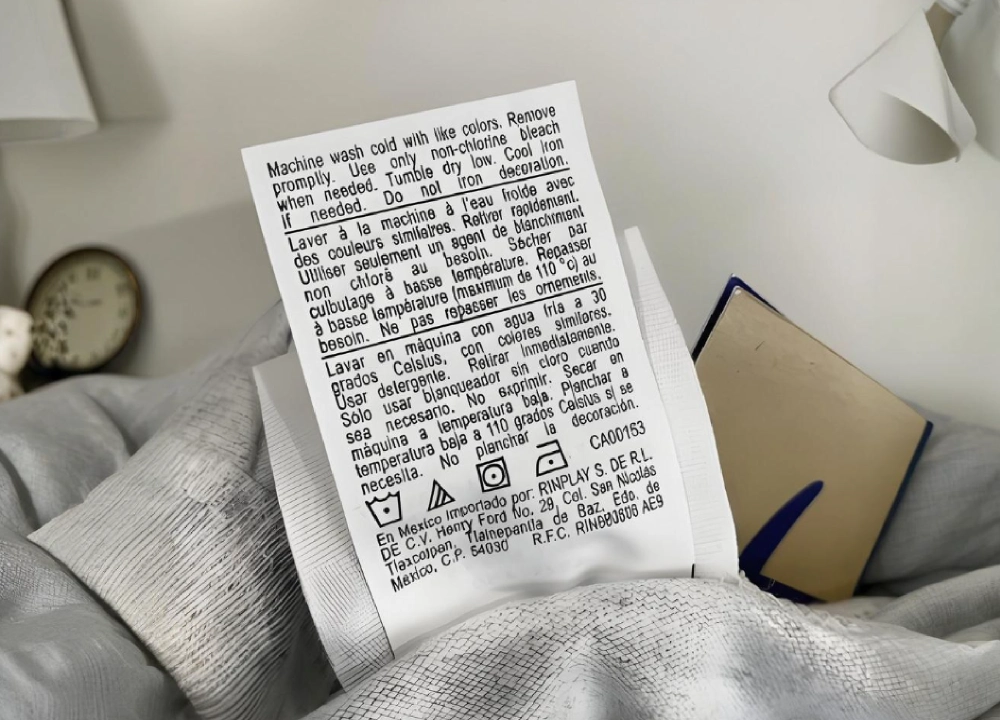
EU Responsible Person and Importer Obligations: The Hard Threshold After December 2024
Legal basis: GPSR (EU) 2023/988, the General Product Safety Regulation.
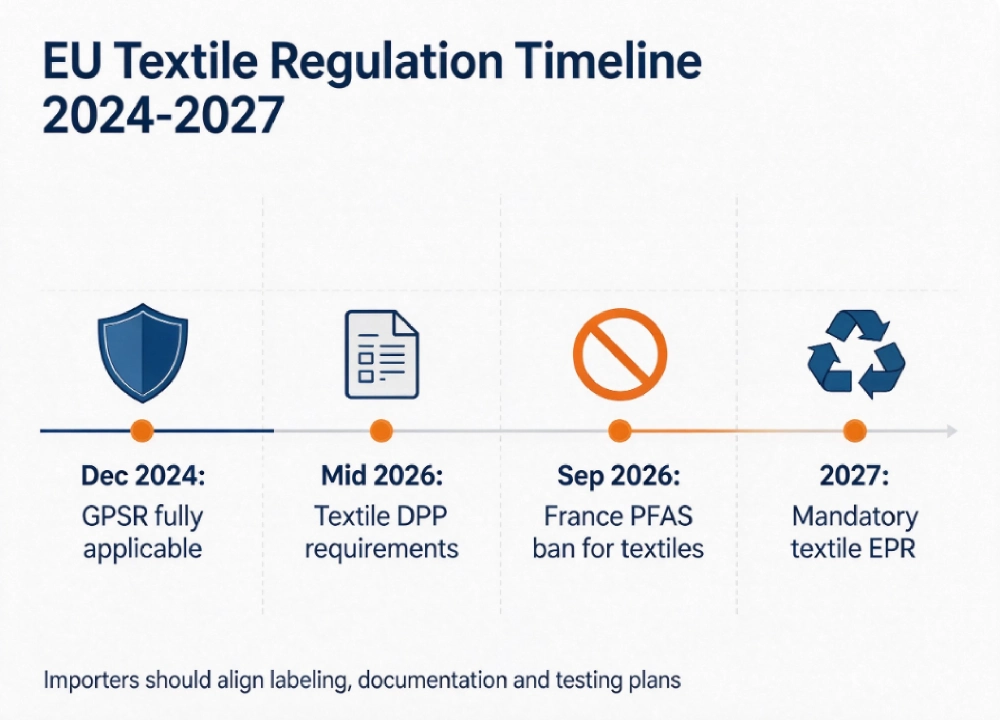
It has applied in full since 13 December 2024 and replaces the old GPSD 2001/95/EC. Because it is a Regulation rather than a Directive, it applies directly in every Member State.
As an importer bringing goods from China, where do you sit in this system? GPSR establishes a clear chain of responsibility: manufacturer, then authorised representative where required, then importer, then distributor. When you place a custom order in China, your legal identity is importer, which means the following.
You carry an independent product safety responsibility. You cannot be exempted on the grounds that “the factory is the manufacturer”.
The information that apparel products must provide:
Information required for apparel products
| Information category | Specific content | Source |
|---|---|---|
| Manufacturer information | Name, postal address, electronic address (email) | Chinese factory |
| Importer information | Your company name, EU address, email | You |
| Product identification | Product name or model, batch or serial number | Agreed between both parties |
⚠️Important: this information does not all have to be sewn onto the care label.
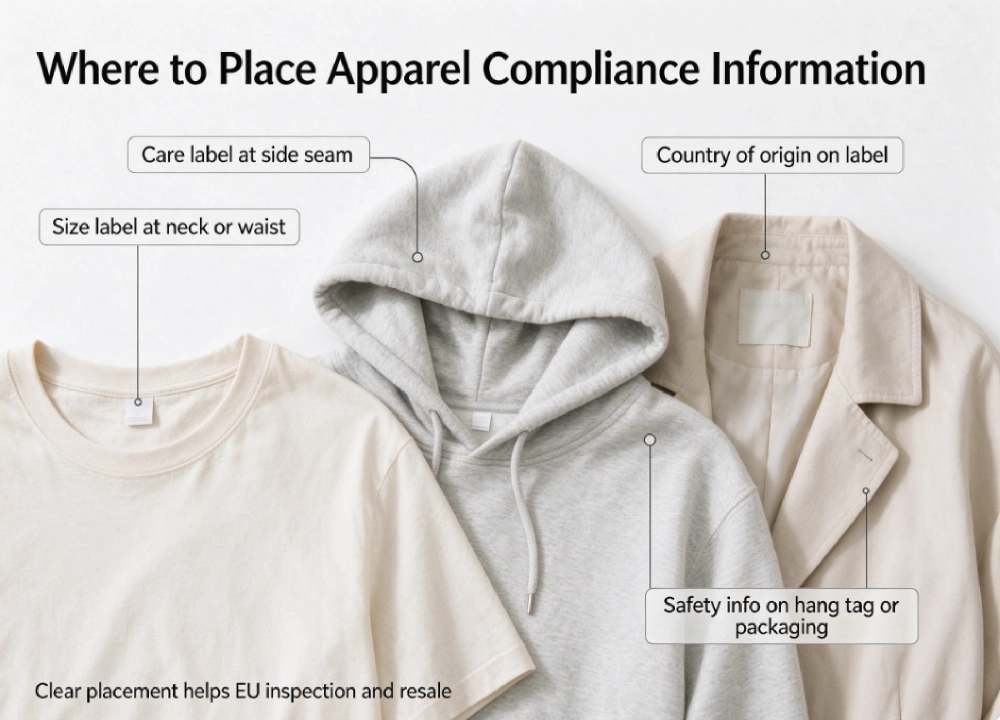
GPSR allows the information to appear in any one of the following places:
- on the product itself (care label);
- on the product packaging or hang tag;
- in accompanying documents;
- on a website address marked on the product or its packaging.
The prevailing practice in the apparel industry is as follows.
Where information is usually carried
| Location | Content marked |
|---|---|
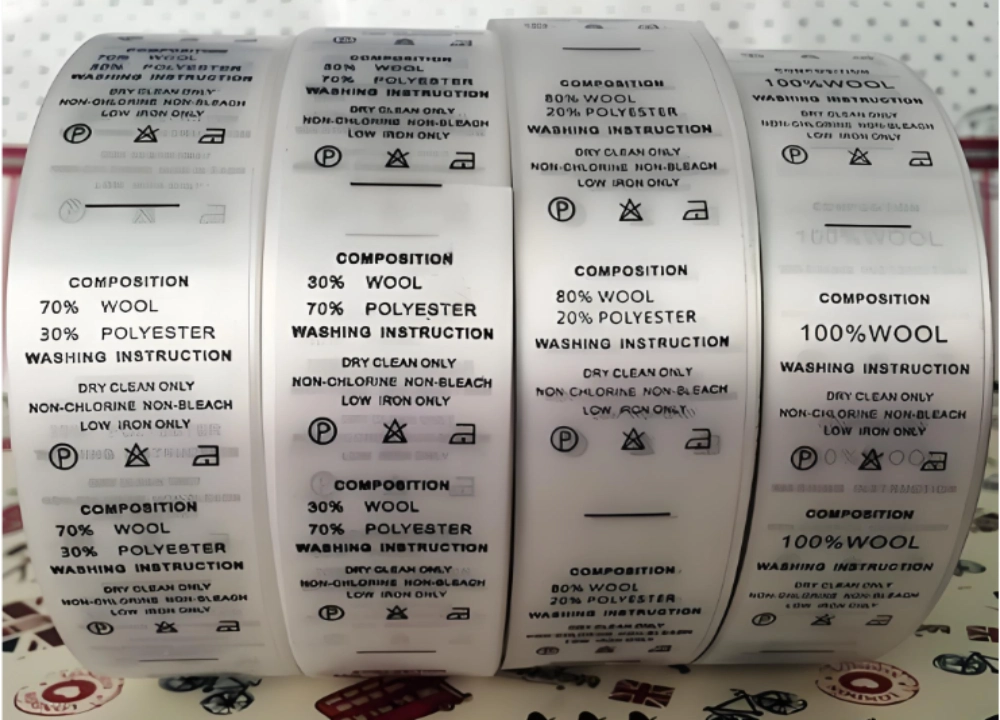
| Care label (sewn in) | Fibre composition (multi-language), care symbols, country of origin |
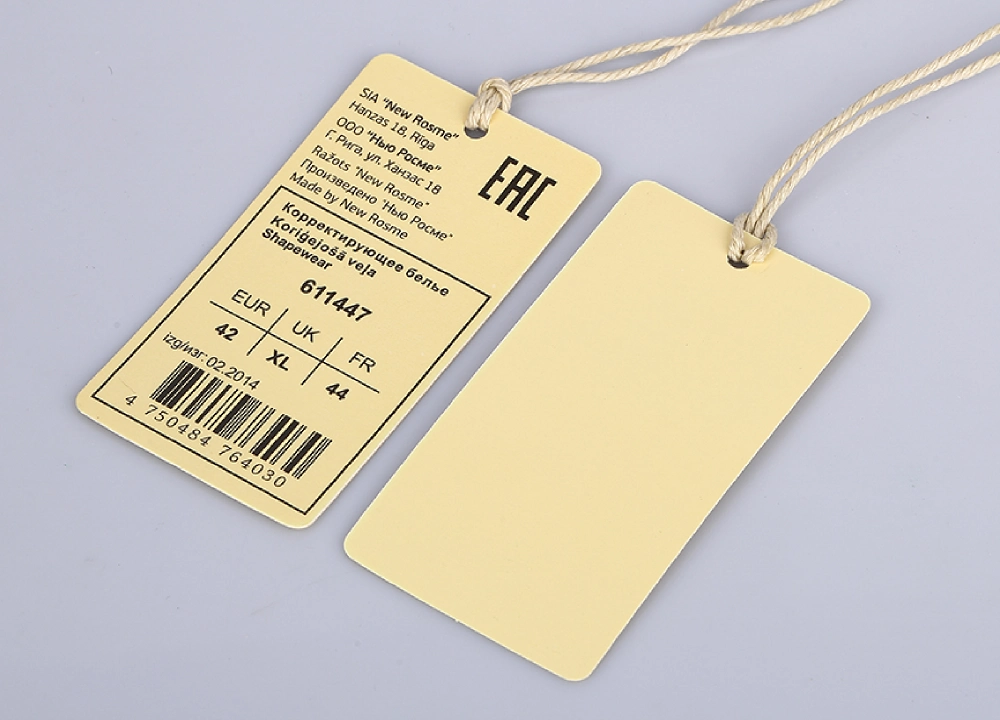
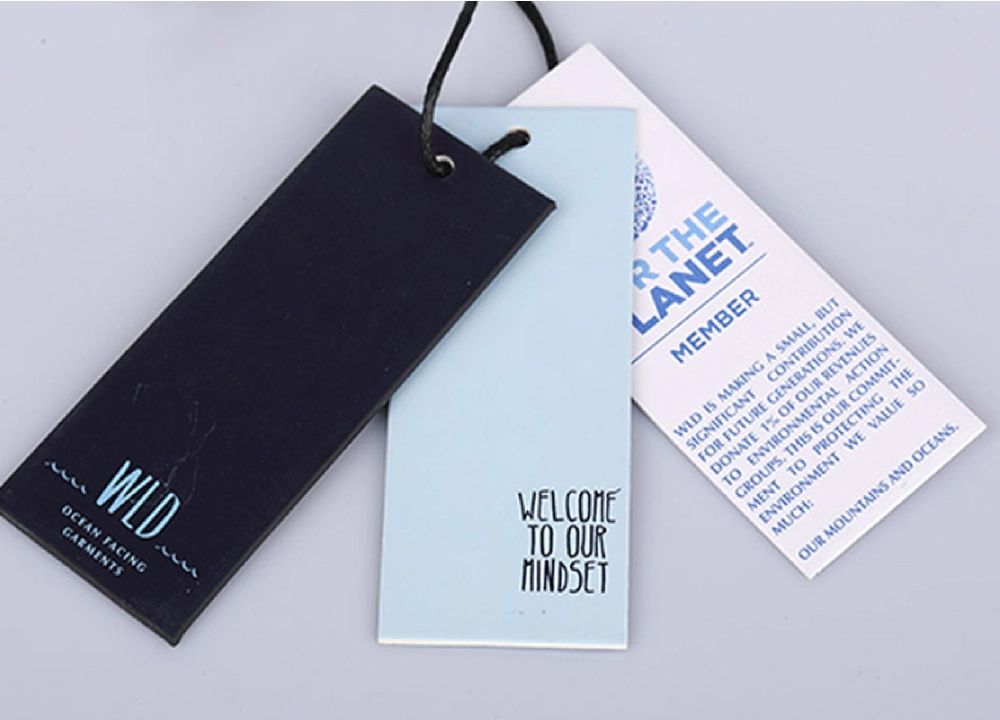
| Hang tag / packaging | Manufacturer name and address, importer name and address, batch number, product name and model |
This satisfies compliance without making the care label so long and stiff that it spoils the wearing experience.
But note: wherever you put it, the information must be complete and accessible.
⚠️This is the item most often missed: many Chinese factories print only “Made in China” and the fibre composition on their labels, with no complete manufacturer contact details and certainly no importer information. This is a mandatory requirement introduced after December 2024, and all legacy label and hang tag templates need to be updated.
Why this matters especially for you
- Customs and market surveillance. Market surveillance authorities in each Member State can hold you liable directly, rather than pursuing a Chinese factory thousands of kilometres away.
- Platform controls. Amazon, AliExpress, eBay and other platforms already enforce the same rules: economic operator information that is not fully uploaded leads to listings being removed or blocked.
- Recall costs. If a recall happens, you as the importer are the first responsible party, and your ability to trace depends on whether batch number management is properly in place.
⚠️ A common misconception: some wholesalers assume that because they operate as a private label and own the brand, they only need to print their own details. This is wrong. GPSR requires manufacturer information to be retained.
If you re-label goods under your own brand name, you may in law be treated as the manufacturer and take on heavier technical documentation and compliance obligations. This must be agreed explicitly with the factory before the order is placed.
Chemicals: REACH Is the Silent Killer, and 90% of the Problems Come from Fabric
Legal basis: REACH (EC) No 1907/2006.
This is where Chinese factories most often fail, because the problem usually arises in the dyeing and finishing processes of the fabric supplier rather than in the garment factory itself. As the importer you cannot directly control the fabric mill, so you have to lock down responsibility through contracts and testing.
Quick reference to the most frequently controlled items in textiles:
High-frequency restricted substances in textiles
| Substance | Limit | Common source |
|---|---|---|
| Azo dyes | ≤30 mg/kg | Dark-coloured fabrics, prints |
| Nickel release | ≤0.5 μg/cm²/week | Buttons, zippers, metal trims |
| Lead | ≤500 mg/kg | Print pastes, metal accessories |
| Hexavalent chromium | ≤3 mg/kg | Leather articles |
| Phthalates | Total of 6 ≤0.1% | PVC coatings, offset printing, plastic accessories |
| PFAS | New restrictions from September 2024 | Waterproof fabrics, outdoor jackets |
⚠️Note: REACH controls chemical substances and does not distinguish between end uses.
The same fabric is non-compliant whether it becomes apparel, curtains, sofa covers or automotive interiors, as long as it contains a restricted substance. What does differ is the strictness of testing by end use: OEKO-TEX STANDARD 100 divides products into four classes.
OEKO-TEX STANDARD 100 product classes
| Product class | Scope | Strictness |
|---|---|---|
| Class I | Articles for babies and toddlers (under 3) | Most stringent |
| Class II | Articles in direct contact with skin (underwear, T-shirts, bedding) | Stringent |
| Class III | Articles not in direct contact with skin (outerwear, linings) | Moderate |
| Class IV | Decorative materials (curtains, tablecloths, upholstery) | Relatively lenient |
This means: if you buy both apparel and home textiles, the testing class for the fabric must match each end use respectively, and one report cannot be used for both.
Three practical recommendations:
- Ask the Chinese factory for the fabric REACH test report instead of relying on verbal assurances. The report should be issued by an accredited third-party laboratory and correspond to the specific fabric batch.
- Prefer fabrics that already hold OEKO-TEX STANDARD 100 certification. Note that this is a voluntary eco-label rather than a mandatory EU market access requirement, but it is a valid way of demonstrating REACH conformity and can substantially reduce testing costs.
- Send metal accessories for separate testing. Buttons and zippers are the items that most often exceed limits.
Tightening at Member State level: France has banned textile apparel containing PFAS from 1 January 2026, and Denmark has banned garments with a total fluorine content of ≥50 mgF/kg from 1 July 2026. If your product has a waterproof function and is sold into either country, pay particular attention.
Follow our fabric sourcing guide for apparel to build a repeatable workflow for compliant material selection.
Fabric Sourcing: Why It Decides Whether Compliance Succeeds
Every compliance question above – whether the composition labelling is accurate, whether REACH is satisfied, whether the OEKO-TEX class matches – ultimately depends on which fabric you chose.
And fabric purchasing is precisely the link that European clients find hardest to control themselves:
- you cannot personally walk every fabric market in China;
- suppliers verbally promise “EU compliant” without any supporting report;
- the same fabric can differ substantially in chemical composition from one dye lot to the next;
- responsibility between the fabric mill and the garment factory is vaguely divided, and each blames the other when something goes wrong.
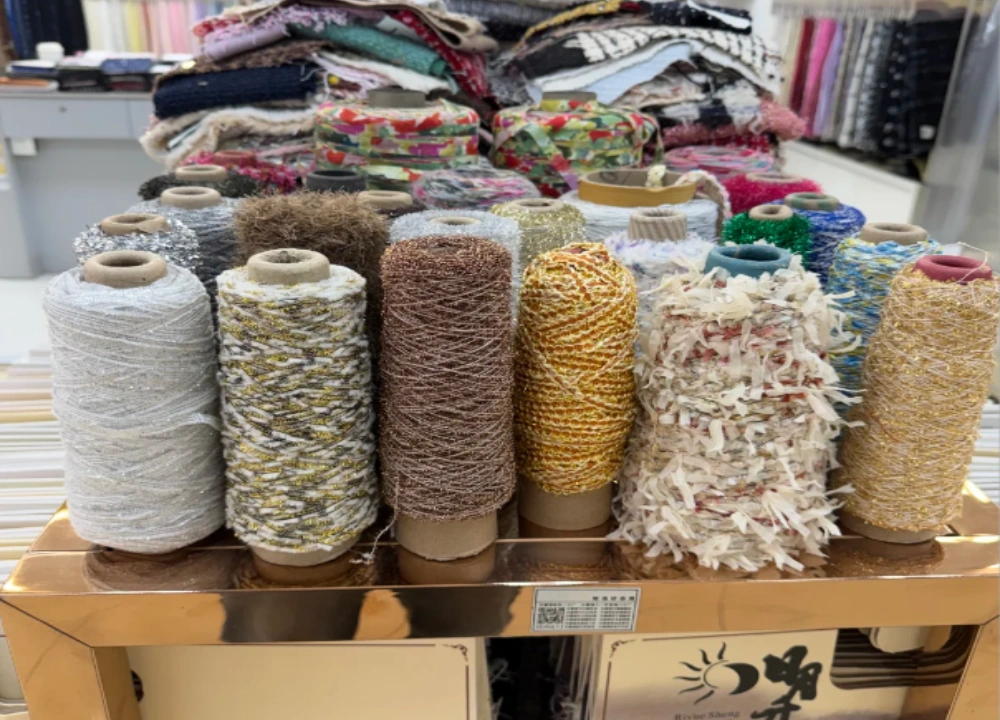
Zhongda International Textile Trading Centre in Guangzhou: the world’s largest fabric hub
Zhongda Textile Trading Centre sits in Haizhu District, Guangzhou, and brings together tens of thousands of fabric merchants, making it one of the most concentrated fabric resources in the world.
Main fabric categories at Zhongda
| Category | Coverage |
|---|---|
| Knitted fabrics | Jersey, rib, sweatshirt fleece, polar fleece, mesh |
| Woven fabrics | Cotton, poplin, twill, chiffon, linen, blends |
| Denim | Various weights, wash processes, stretch denim |
| Functional fabrics | Waterproof, windproof, breathable, antibacterial, flame retardant |
| Home textiles and decorative fabrics | Curtain fabric, upholstery, bedding fabric |
| Trims and accessories | Zippers, buttons, webbing, interlining, sewing thread |
For European clients, the advantages here are:
- complete category coverage – apparel fabric, home textile fabric and decorative fabric can all be sourced in one district;
- fast sampling – most merchants support small-lot cuttings, which makes early testing convenient;
- transparent pricing – intense competition means there is real room to compare;
- a complete supply chain – from fabric to trims to garment processing, everything can be solved within a few kilometres.
But opportunity comes with risk: merchant standards vary widely. Many small and medium merchants have no experience exporting to the EU, do not understand the specific requirements of REACH and OEKO-TEX, and cannot even provide a valid test report. Some suppliers will fob you off with an expired certificate or somebody else’s report.
If you plan to source fabrics locally in Guangzhou, our Zhongda Fabric Market sourcing guide walks you through market navigation, sampling and supplier verification.
SourcingYuan’s fabric sourcing and quality control service
We work with a long-standing supplier network inside Zhongda and can take you through the whole process from sourcing to quality control:
SourcingYuan fabric service
| Service step | Specific content |
|---|---|
| Fabric sourcing | Match compliant suppliers to your product positioning and price range; provide multi-option quotations |
| Sample collection | Collect fabric swatch cards and cuttings in one place and ship them to you for confirmation |
| Compliance pre-screening | Verify the authenticity and validity of the supplier’s OEKO-TEX certificate and confirm whether the product class matches your end use |
| Testing arrangement | Coordinate with third-party laboratories and arrange testing for the relevant REACH Annex XVII items |
| Batch control | Spot-check bulk fabric on arrival to ensure it is consistent with the submitted sample |
| Document archive | Compile a complete fabric compliance file to support platform audits and market surveillance checks |
Core value: you do not need to walk the market yourself, judge supplier qualifications yourself, or deal with laboratories yourself. Tell us your fabric requirements, and what we deliver is compliant fabric ready for the EU market plus a complete documentation pack.
Children’s Clothing: Drawstrings Are the Inspection Focus
If your range includes children’s wear, this section deserves close attention.
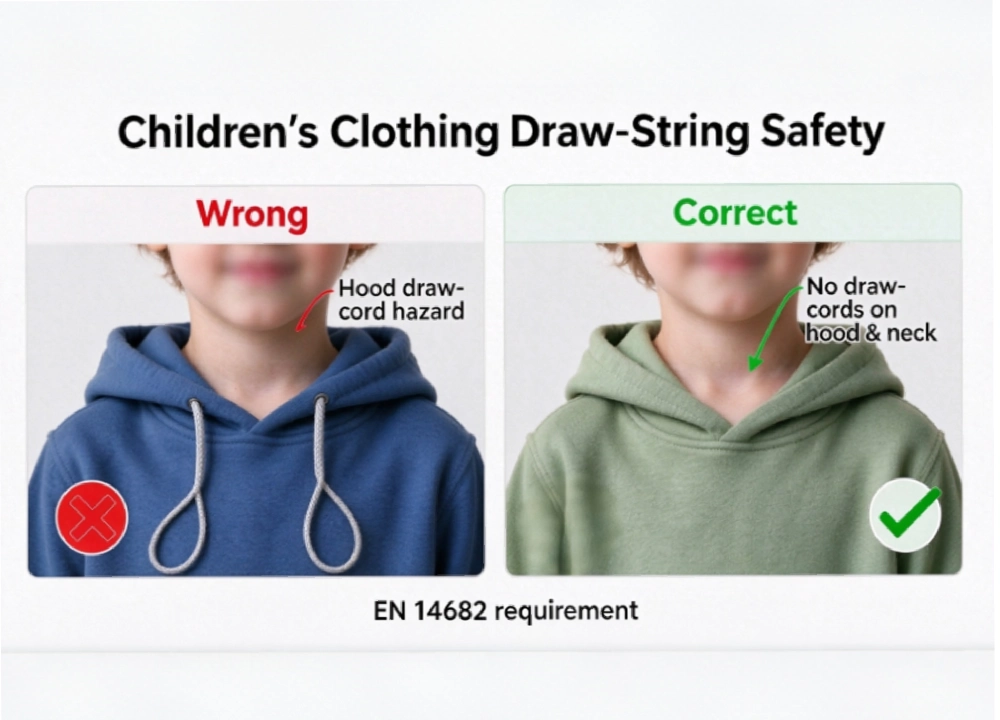
EN 14682 – Safety of children’s clothing, cords and drawstrings – applies up to age 14 and is the highest-frequency failure item in EU market surveillance.
Core restrictions:
- no cords or drawstrings in the head and neck area (risk of strangulation);
- strict limits on the length of free ends;
- strict limits on the circumference of loops.
EN 14878 – Burning behaviour of children’s nightwear fabrics.
⚠️Hard-won lesson: when an adult sweatshirt design is converted into a children’s version, the original pattern is often reused as-is with the hood cord left in place. This is the most typical violation. Always run a separate EN 14682 assessment for children’s orders; do not assume the factory will handle it automatically.
Additional point on children’s fabrics: fabrics for babies’ and children’s garments must be tested to OEKO-TEX product class I, whose limits are far stricter than for adult apparel. If a supplier only provides a class II or class III report, it cannot be used for children’s wear.
Add compliance checks to your sample sign‑off process; our garment sampling guide offers a complete structured workflow.
Care Labels: Not Mandated by Law, but Practically Essential
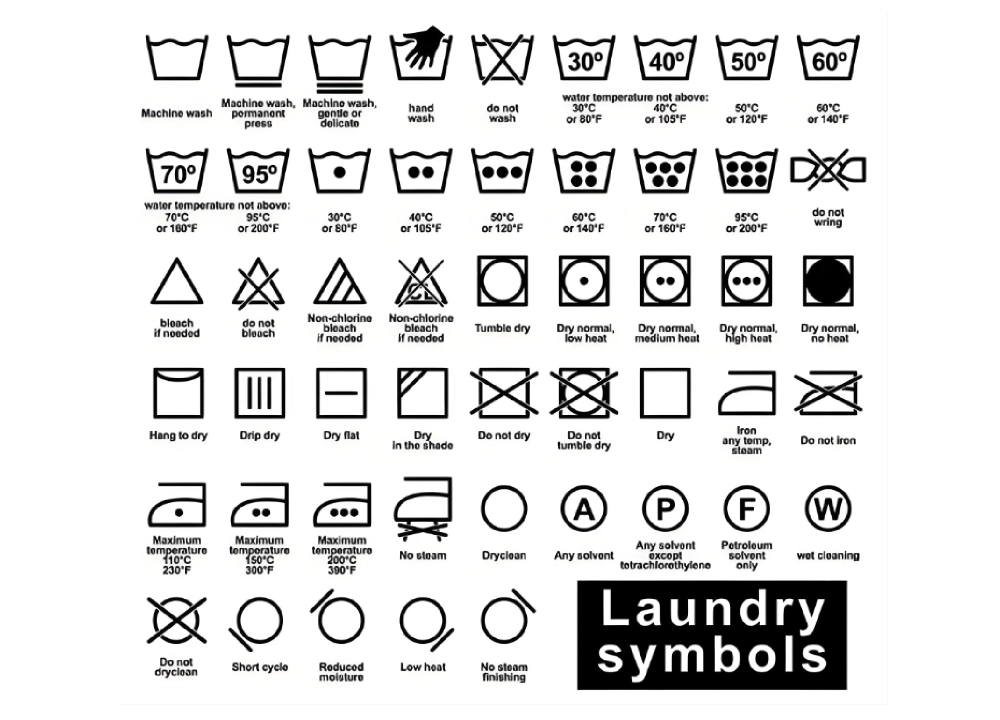
EN ISO 3758 defines the care labelling symbol system in five groups: washing, bleaching, drying, ironing and professional maintenance.
There is one point that is easy to confuse:
Regulation 1007/2011 itself does not make care labelling mandatory.
But GPSR requires products to be safe to use throughout their foreseeable lifecycle, so in practice care labelling has become a de facto necessity. Products without care labels can hardly pass retailer acceptance in the EU market.
One further note: accuracy of the care symbols matters just as much. If a garment is marked machine-washable but in reality shrinks or fades, that also constitutes a misleading product description and may expose you to consumer claims.
Looking Ahead: Three Big Changes for 2026-2027
This part determines your purchasing strategy for the next three years, and it is worth planning for in advance.
Digital Product Passport (DPP)
Under ESPR (EU) 2024/1781, the Ecodesign for Sustainable Products Regulation, textiles are among the first priority product groups.
In May 2026 the European Commission published its study report on DPP content for textile and apparel products, specifying that disclosed content will include:
- fibre composition, SVHC names and concentrations;
- durability score, recycled content share, organic content;
- environmental footprint, care instructions and warranty period.
The identification system uses GTIN-13 / SGTIN plus batch coding.
What does this mean? Every batch you ship in future will need a traceable data chain. Choosing a factory with ERP/MES integration will matter more than simply comparing prices – a factory that cannot provide data may lose its supply qualification entirely within three years.
Ban on destroying unsold products
From 19 July 2026, large enterprises are prohibited from destroying unsold apparel, footwear and accessories. From February 2027 they must disclose discarded quantities and reasons in a standard format.
Impact on purchasing strategy: small-batch, multi-drop, on-demand production models will gain an advantage, while the risk of overstocking rises significantly. This is the main reason we advise clients to adjust their order rhythm.
Extended Producer Responsibility (EPR)
The revised Waste Framework Directive entered into force on 16 October 2025, establishing a mandatory EPR scheme for textiles and footwear.
- all producers, including importers, must pay for collection, sorting and treatment;
- an eco-modulation mechanism applies: the more durable, recyclable and recycled-fibre-rich the product, the lower the EPR fee;
- Member States must transpose it into national law by June 2027.
Cost note: this fee will ultimately show up in your product cost. Designing for mono-material construction and easy disassembly at the design stage is a genuine way to save money.
Pre-Order Checklist
We suggest printing this out and working through it directly.
Design stage
- Confirm the destination countries of sale and fix the label language plan.
- Run a separate EN 14682 drawstring assessment for children’s wear.
- Assess whether the product has waterproof or stain-resistant functions (PFAS risk).
- Consider mono-material design to reduce future EPR fees.
Fabric sourcing and quality control
- Verify the authenticity, validity and product class of the fabric OEKO-TEX certificate.
- Request the fabric REACH test report (issued by a third-party laboratory, corresponding to the specific batch).
- Send metal accessories (buttons, zippers) for separate nickel release testing.
- Confirm the accurate fibre percentages of the fabric (needed for label production).
- Spot-check bulk fabric on arrival to ensure it matches the submitted sample.
Label production
- Use the official fibre names from Annex I of Regulation 1007/2011.
- List composition in descending order by weight, totalling 100%.
- Label each component of multi-component products separately.
- For products containing leather, fur or down, include the animal origin statement.
- Care symbols must comply with EN ISO 3758.
- Labels must be sewn in or permanently printed; no stickers.
GPSR information marking
- Complete manufacturer information (name, address, email) – sewn in or on the hang tag.
- Importer information (your company name, EU address, email) – sewn in or on the hang tag.
- Product name and batch number.
- Confirm where the information sits: care label or hang tag, either is acceptable, but it must be complete.
Supplier management
- Confirm the factory has experience exporting to the EU.
- Confirm the factory has an ERP/MES system (in preparation for DPP).
- State clearly in the purchasing contract: who owns fabric compliance responsibility, who keeps the test reports, and the rework and compensation liability in case of non-compliance.
- Run full third-party testing before bulk production, not just on the first sample.
What SourcingYuan Can Do for You
The checklist above may look long, but for a purchasing team familiar with the EU market these are routine actions that should be confirmed at the sampling stage.
As your sourcing partner in China, SourcingYuan’s core strength lies in front-end control at the fabric stage:
- Fabric sourcing: drawing on the supplier network in Zhongda Textile Trading Centre in Guangzhou, we match compliant fabrics and provide multi-option quotations.
- Fabric quality control: we verify OEKO-TEX certificates, arrange REACH testing and spot-check bulk goods to ensure consistency with the submitted sample.
- Compliance confirmation before sampling: we help you settle the label language plan and composition marking format, avoiding rework after labels are printed.
- In-production inspection: GPSR label information, EN 14682 children’s drawstrings and care symbols are built into our standard inspection checklist.
- Deliverable documentation pack: we compile a complete compliance file to support platform audits and market surveillance spot checks.
All you need to do is confirm the design and the price. Fabric sourcing, quality control and compliance detail are on us.
If you are preparing your next season’s orders, send us your product requirements. We will come back with a compliance assessment tailored to your category and fabric recommendations from Zhongda Textile Trading Centre.
Contact:
Mary_sourcingyuan
WeChat / WhatsApp: +0086 18550086956
Email: mary@sourcingyuan.com
About the Author
Jeff Lee
Founder of Sourcingyuan
Jeff Lee is the founder of Sourcingyuan, a China-based sourcing and product development company. He has more than 10 years of experience helping overseas businesses source products, develop new products, identify reliable manufacturers, manage production, and build supply chains in China.
Related Articles You May Like 📚
Explore more from our apparel sourcing resources:
📋 Why a Tech Pack Is Essential for Successful Apparel Sourcing
👕 How to Navigate Garment Sampling: A Complete Apparel Sourcing Guide
✅ How to Inspect Apparel Quality Before Shipment: An Apparel Sourcing Guide
🤝 Need help with EU compliance checks before your next custom apparel order?
Share This Story, Choose Your Platform!
We connect you with reliable factories, get the best quotes, deliver straight to your door.